


Biology's hardest problems, solved and validated.
A closed-loop, recursive AI system with full in silico validation to solve the unsolvable.

“We gave Nextflow Frontier one of the hardest problems in our field: predicting how mutations change protein binding affinity. On our own held-out data, the model it built outperformed every published method we tested, including recent deep learning approaches”

BioML-bench · 24 tasks
Breakthrough benchmark performance
We tested our system against bioML-bench, a set of 24 tasks designed for testing agentic systems. Our system out-performed other published agentic systems in nearly every computational area.

| Task area | Nextflow Frontier | Best published AI system | Difference |
|---|---|---|---|
| Drug discovery | 96th | 67th | +29 pts |
| Protein engineering | 94th | 97th | −3 pts |
| Single-cell omics | 96th | 88th | +8 pts |
| Biomedical imaging | 76th | 46th | +30 pts |
| All 24 tasks | 92th | 75th | +17 pts |
Each bar is a leaderboard percentile: on each task, the share of BioML-bench leaderboard entries a system beats, averaged over the tasks in that area. These are not the task scores in the table below or the result posts. Best of the rest is the highest-scoring published AI system in each area, from 2025–2026 BioML-bench results, graded on the same leaderboard snapshot where per-task scores exist. Nextflow Frontier bests were selected on the test set. Biomedical imaging tasks were scored on a re-split of Kaggle training labels.
 Read the results
#1 Benchmark
Drug Discovery
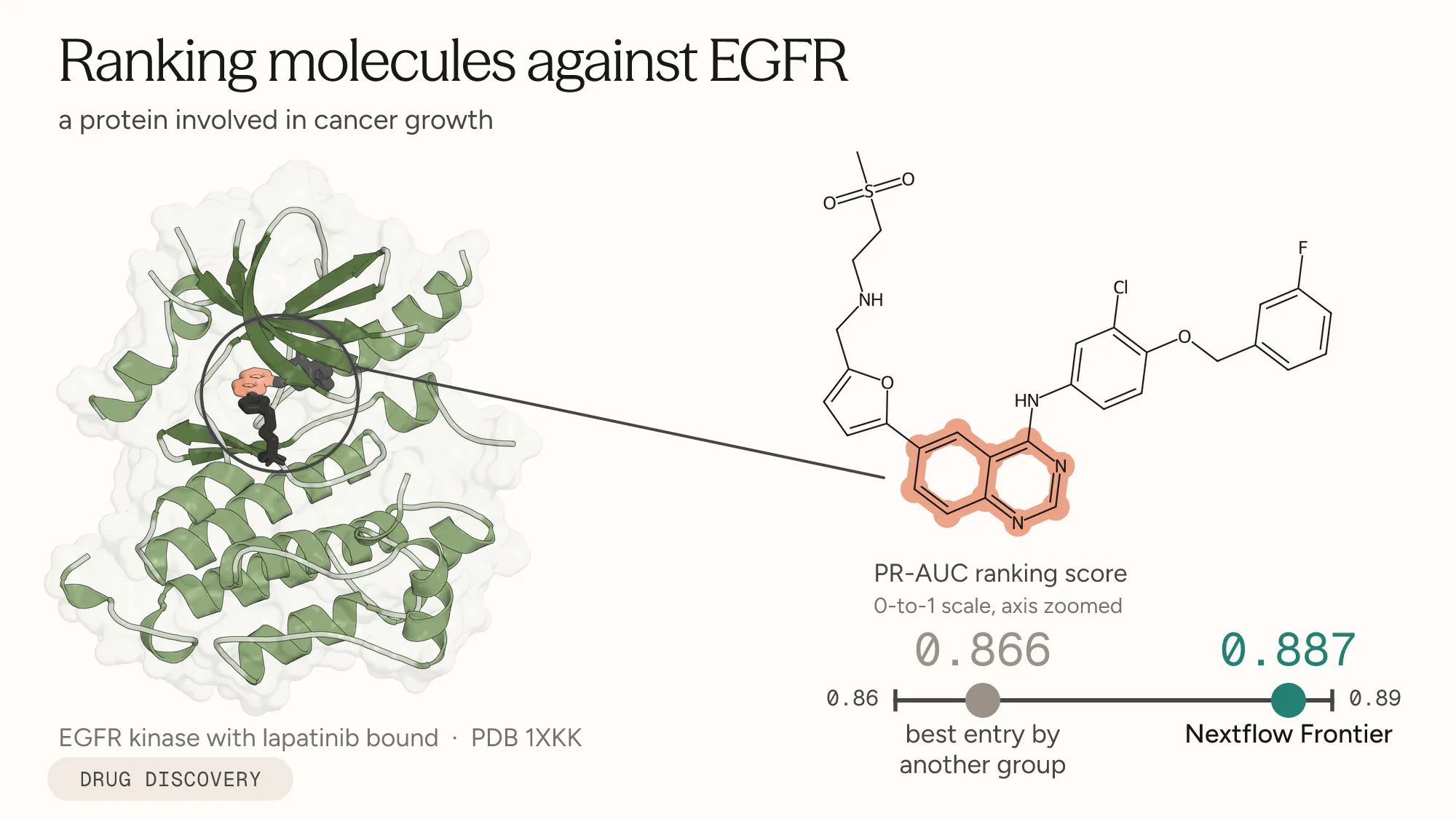
We built two simple, readable chemistry models and combined them to rank molecules by how likely they are to bind EGFR, a protein involved in cancer growth.
 Read the results
#2 Benchmark
Biomedical Imaging
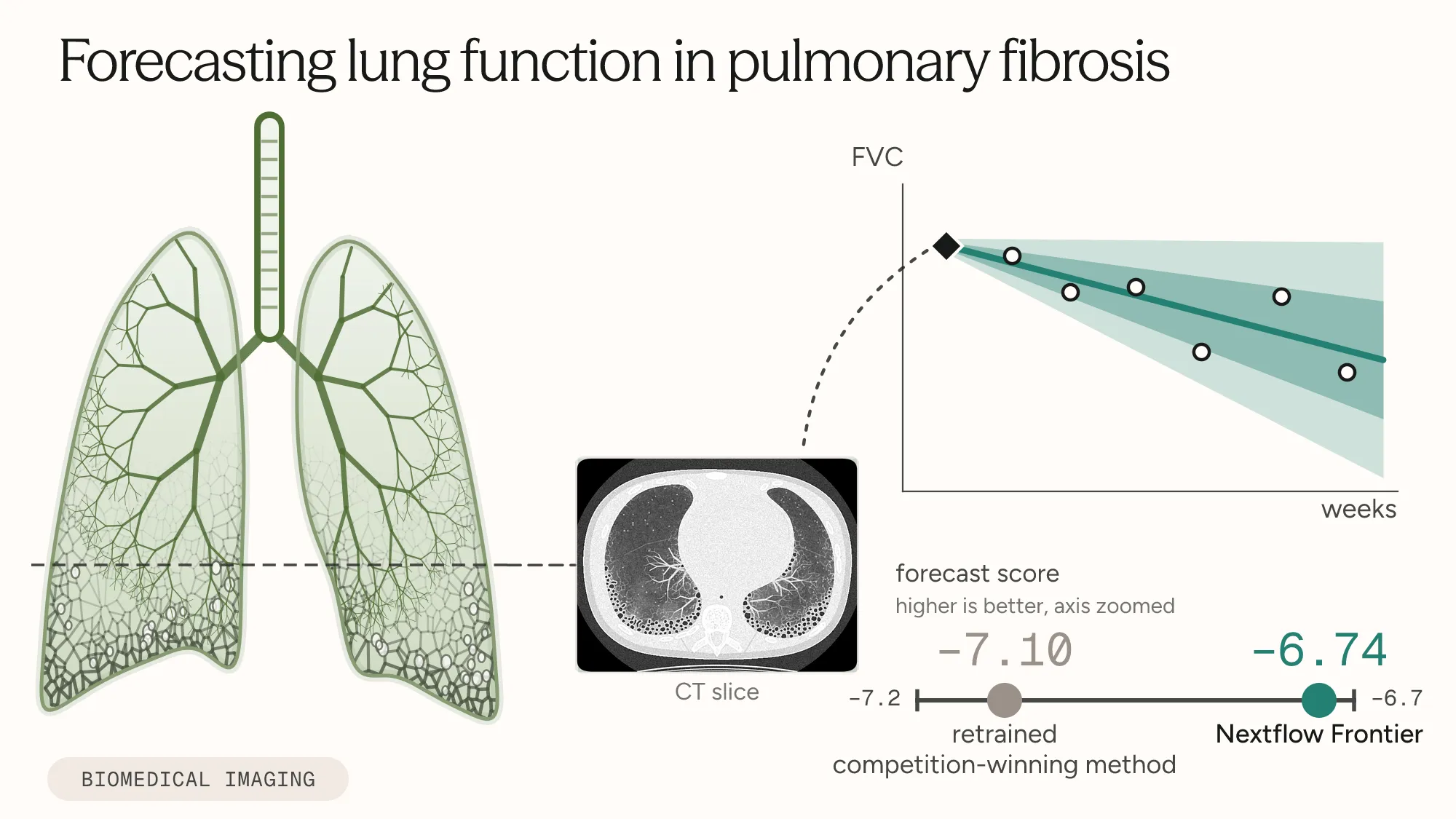
We combined CT measurements with clinical information to forecast lung function and prediction uncertainty in pulmonary fibrosis.
 Read the results
#3 Benchmark
Protein Engineering
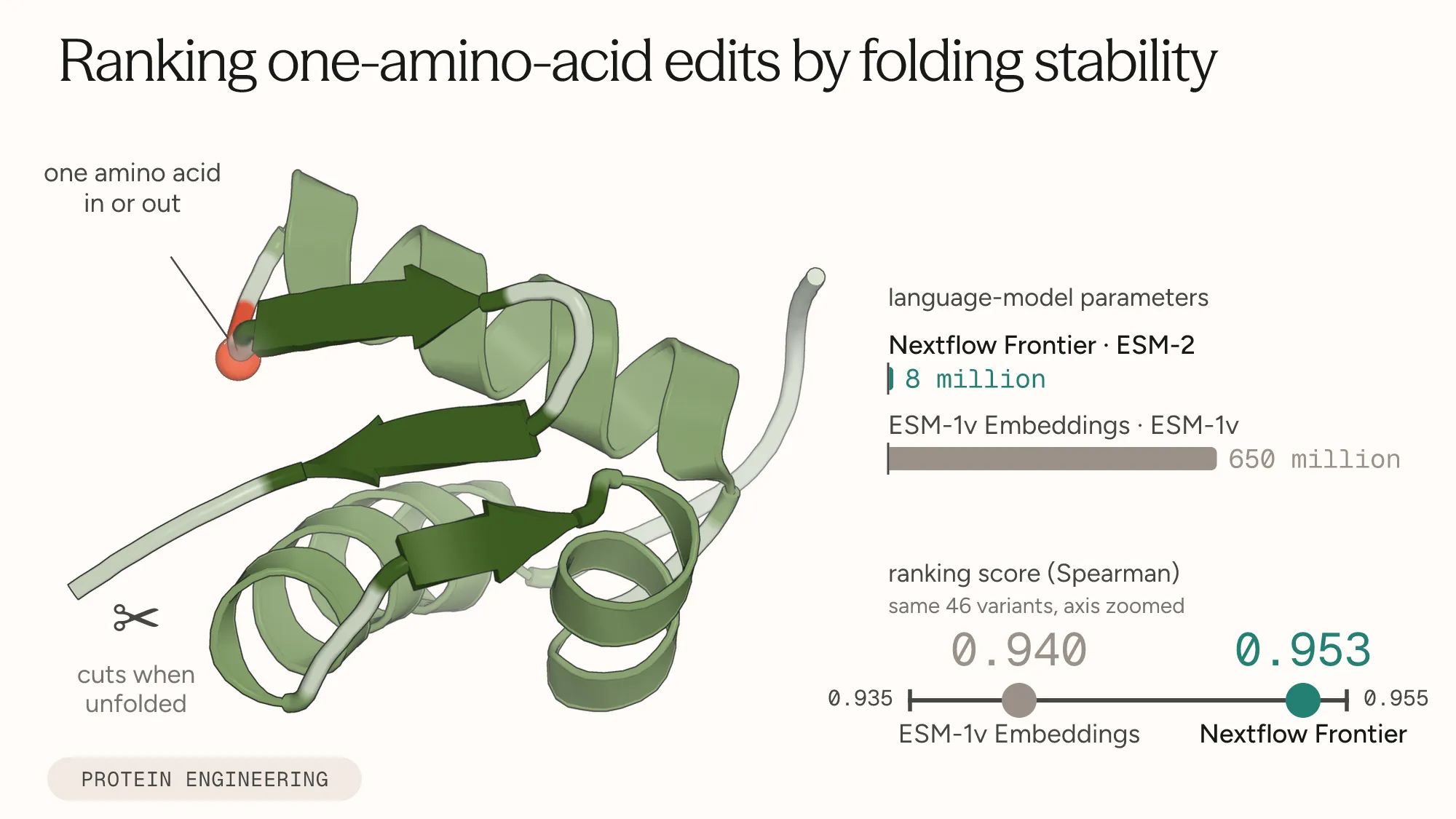
We adapted a protein language model to rank insertions and deletions in a mouse CSN4 domain by experimentally inferred folding stability.
 Read the results
#4 Benchmark
Single-Cell Omics
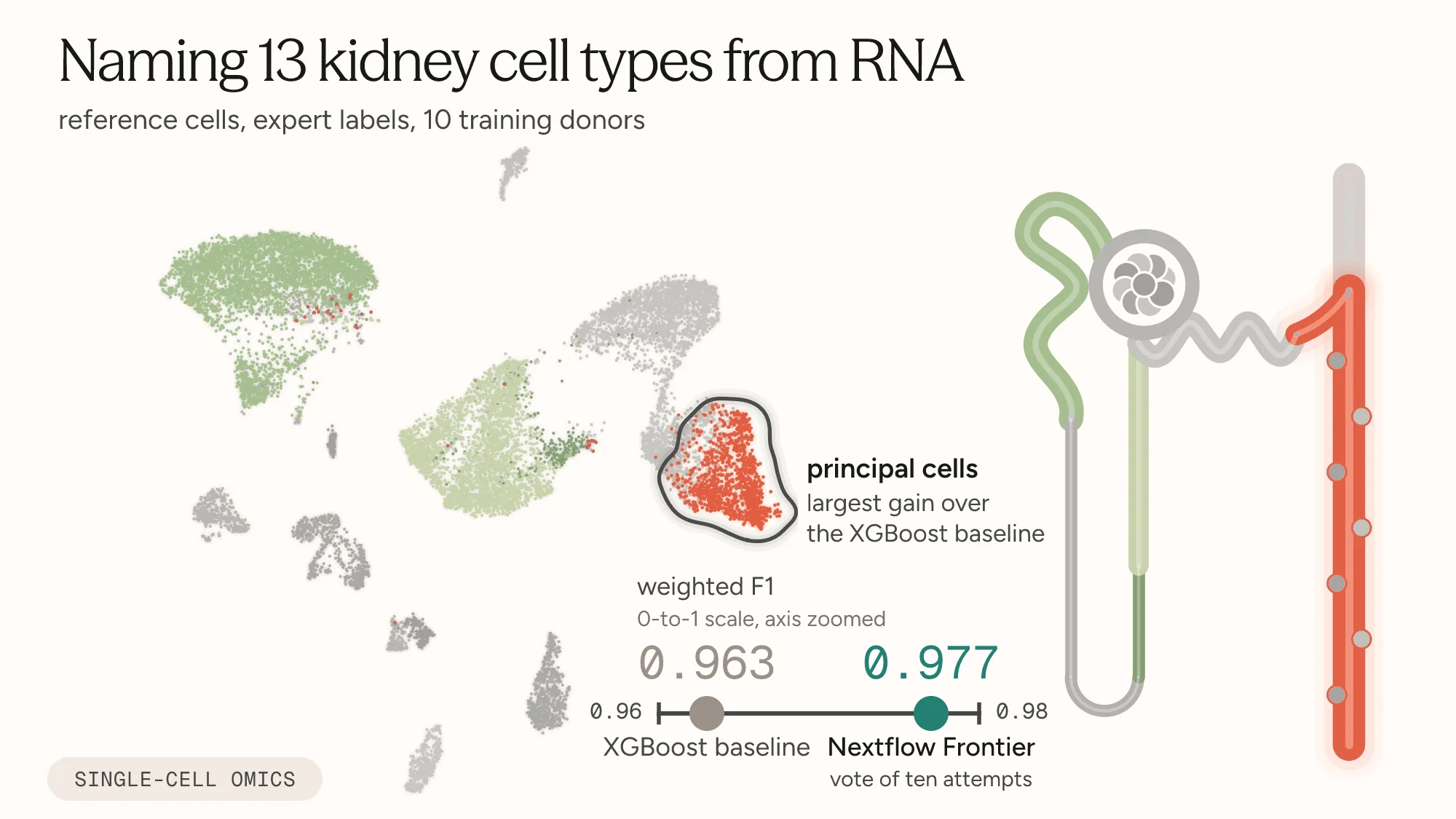
We trained boosted decision trees on the genes that vary most between cells to name cell types in kidney single-nucleus RNA profiles.



Nextflow Frontier best | Competing method best | |||
|---|---|---|---|---|
 Naming kidney cell types Naming kidney cell types | Single-cell omics | 0.977 weighted F1 | 0.963, XGBoost | Ahead, beyond margin of error |
| Predicting protein levels from RNA | Single-cell omics | 0.604 RMSE (lower is better) | 0.724, KNNR (Py) | Ahead, beyond margin of error |
| Forecasting lung-function decline | Biomedical imaging | −6.74 log-likelihood (higher is better) | −7.10, retrained competition-winning method, same patients | Ahead, beyond margin of error |
| Ranking compounds for EGFR activity | Drug discovery | 0.887 PR-AUC | 0.866, 1B_MPNN_MolGPS-ens_LargeMix | Within margin of error |
| Predicting how fast the liver clears a drug | Drug discovery | 0.796 Pearson r | 0.787, AceProp1 | Within margin of error |
How it works
A Recursive, Closed-loop Discovery System
Scientific evaluation at every stage

Adaptive Discovery Model
Intelligent optimization & orchestration of every step
Hypothesis
- 01Planning and DesignDesign experiment, select data, models, and tools. Craft novel methods
- 02ExecutionRun thousands of pipelines in parallel on your compute
- 03ValidationEvaluate outcomes and assess confidence
- 04LearningAnalyze results to inform the next round of experiments
Lab
Scientists guide the loop with full visibility, control and auditability


























We deliver novel models and methods
Designed to be problem-agnostic, Nextflow Frontier generates solutions in any computational area where success can be measured.
Target Discovery & Validation
Structure Prediction
Ensemble Sampling
Epitope Modeling
De novo Design
Hit2Lead Optimization
Binding Affinity
Virtual Cell
ADME & Toxicity
PK & PD modeling

The Stack
The technology behind the intelligence


Data
- Internal data


- Public data
- Program traces
Tools and models
- 2000+ tool registry
- SOTA models, MCPs
- Proprietary and open LLMs
Connectors:Proprietary connectors integrate into any custom environment

Control Panel
Advanced steering and observability system for scientists
Research Harness
Technical orchestration and context engine
Adaptive Discovery Model
Underlying, self-learning intelligence layer optimizing and orchestrating the discovery loop
Proprietary Agentic Nextflow
Custom Nextflow dialect designed for massively parallel agentic runs
Nextflow Platformby


- Compute
- Governance
- Security
- Auditability
- Provenance
Connectors:Proprietary connectors integrate into any custom environment
“Nextflow Frontier marries the most advanced AI reasoning with massively scaled pipeline verification to deliver in silico science with unprecedented power.”

Customer Control
Discovery, on your terms
Unlock the power of your data. Zero egress or training on your data.
Guide the loop with full visibility. Every hypothesis, test, and result, traceable and interpretable in minutes.
Integrate all your complex systems across organizations with 160+ proprietary connectors.
Run inside your own environment, within your security perimeters.
Works within your organization’s governance patterns. Every action fully auditable.
Own the custom models and methods we deliver.